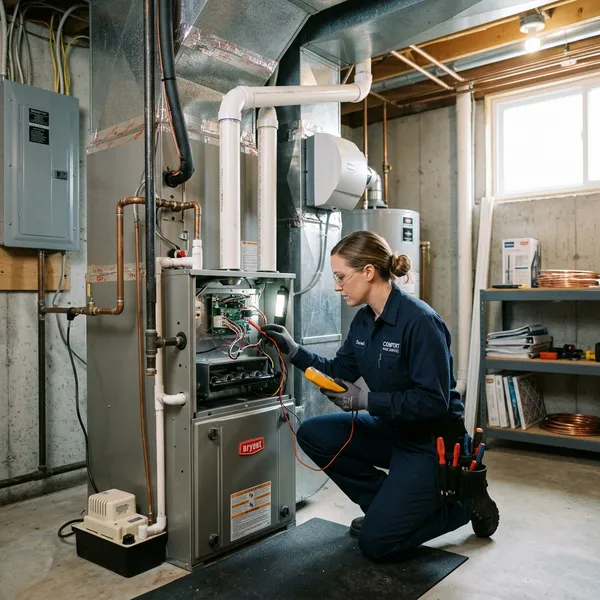
Investing in a new home heating system is one of the most critical mechanical decisions you will make for your Westmoreland County residence. At Greensburg Heating & Cooling, we deliver precision residential heater installations engineered around the unique architectural and climatic realities of Western Pennsylvania. Our factory-certified HVAC technicians replace obsolete, fuel-wasting heaters with advanced two-stage and modulating systems that cut winter energy costs by up to 35% while providing whisper-quiet, balanced warmth throughout every room.
Unlike low-bid contractors who cut corners by relying on crude square-footage guesswork, our engineering team performs thorough ACCA Manual J heat load calculations, static duct pressure audits, and precision digital combustion commissioning on every single installation. Whether you are replacing a failing 20-year-old gas unit in historic Academy Hill or upgrading a mid-century home in Fort Allen to a 98% AFUE condensing system, our certified specialists ensure flawless operation backed by rock-solid 10-year parts and craftsmanship warranties.
Related Heating Navigation & Silo Services:
Local Climate & Home Engineering
Heating a residential property in Greensburg is never a one-size-fits-all proposition. Westmoreland County features diverse home construction styles spanning over a century of architectural development, all situated in a microclimate where winter temperatures frequently plummet below 5 degrees Fahrenheit with heavy snowfall and biting ridge winds.
Greensburg historic districts feature solid masonry brick and plaster walls with little or no cavity insulation. These structures have substantial thermal mass, creating heavy heat loss through uninsulated exterior walls. Many still operate on converted gravity ductwork with oversized, uninsulated sheet metal boots.
Our Engineering Solution: We calculate specific wall heat transmission rates, fabricate custom aerodynamic duct adapters to connect modern blowers to existing duct passages, and install modulating two-stage heaters that supply gentle, constant convective currents to eliminate drafty perimeter walls.
Homes built between 1955 and 1980 in suburban Greensburg neighborhoods often present complex airflow imbalances. Long, uninsulated ranch layouts and multi-level split designs suffer from high static resistance, resulting in ice-cold bedrooms at the far end of supply trunks and overheated lower family rooms.
Our Engineering Solution: We install variable-speed ECM blower systems capable of adjusting static pressure against duct friction. We often enlarge return air drops, incorporate barometric bypass dampening or supply duct dampers, and configure digital multi-stage zoning to balance room temperatures within 1.5 degrees across all levels.
Modern multi-story construction throughout greater Hempfield Township features tight building envelopes, high-efficiency double-pane windows, and high cathedral ceilings. While well-insulated, these homes require exact CFM air delivery to prevent rapid heat stratification where warmth rises and stagnates in 18-foot ceilings.
Our Engineering Solution: We install ultra-high-efficiency 97%+ modulating gas heating systems paired with continuous low-speed air circulation. By keeping air in constant gentle motion, we prevent thermal layering, while integrated whole-home humidification protects hardwood floors from shrinking during dry Western PA winters.
Scientific Sizing Protocol
In the heating industry, the most common and destructive installation mistake is oversizing. When an inexperienced contractor estimates equipment capacity by glancing at your square footage or copying the capacity printed on your 20-year-old existing unit, your home will almost certainly end up with an oversized system.
An oversized heater operates like an automobile stuck in stop-and-go traffic. It fires at maximum capacity, blasts an intense rush of scorching air through the supply vents, quickly satisfies the thermostat within 4 to 6 minutes, and shuts down abruptly. This cycle, known as short-cycling, causes catastrophic systemic problems:
Before our technicians recommend a single model number, we calculate your home precise heating requirements using Air Conditioning Contractors of America (ACCA) standards:
We measure total floor area, ceiling heights, window orientation, glass U-values, attic insulation R-values, basement foundation wall heat loss, and air infiltration rates based on Greensburg 5 degree Fahrenheit 99% winter outdoor design temperature.
We select heating equipment whose output capacity precisely matches your calculated heat loss, ensuring the unit operates in its sweet spot of continuous, quiet efficiency during the coldest days of January and February.
We test existing supply and return duct cross-sectional areas. We guarantee the new blower motor operates within allowable Total External Static Pressure (TESP) limits (under 0.50 inches water column) to protect against motor burnout.
Equipment Technology Comparison
Modern residential heaters are available across three primary performance categories. Review how standard efficiency, high-efficiency condensing, and premium modulating systems compare in daily comfort, fuel consumption, and long-term operating costs.
| Specification / Feature | Standard 80% AFUE | High-Efficiency 96% AFUE (Recommended) | Premium 98% Modulating AFUE |
|---|---|---|---|
| AFUE Efficiency Rating | 80.0% AFUE | 96.0% to 96.5% AFUE | 97.5% to 98.7% AFUE |
| Burner Operation | Single-Stage (100% On or Off) | Two-Stage (Low 65% / High 100%) | Fully Modulating (40% to 100% in 1% increments) |
| Blower Motor Technology | Single-Speed PSC Motor (High electrical draw) | Multi-Speed ECM Constant Torque Motor | Variable-Speed Communicating ECM Motor |
| Exhaust Venting System | Metal B-Vent into Masonry Chimney | Direct-Vent Schedule 40 PVC / Polypropylene | Direct-Vent Concentric PVC / Polypropylene |
| Combustion Air Intake | Draws conditioned indoor room air | 100% Sealed outdoor combustion pipe | 100% Sealed outdoor combustion pipe |
| Temperature Swing Range | ± 3.0°F to 4.5°F (Noticeable cold drafts) | ± 1.0°F to 1.5°F (Consistent comfort) | ± 0.5°F (Flat-line precision comfort) |
| Estimated Winter Gas Savings | Baseline (Replaces obsolete 60-70% units) | 20% to 28% lower fuel bills | 30% to 38% lower fuel bills |
| Sound Level During Operation | 68 - 72 dBA (Noticeable rushing sound) | 58 - 62 dBA (Library quiet on low stage) | 48 - 54 dBA (Virtually silent continuous air) |
| Rebates & IRA Tax Credits | Does not qualify for rebates | Qualifies for Peoples Gas / Columbia Gas rebates | Up to $600 Federal 25C Credit + Utility Rebates |
Need help choosing? Most Greensburg homes find the optimal balance of upfront cost and long-term payback with a 96% Two-Stage Condensing unit.
Discuss options with an installer →Our Craftsmanship Standard
Over 75% of heating equipment failures trace back to improper installation practices rather than defective factory parts. At Greensburg Heating & Cooling, every technician follows our rigorous 10-stage commissioning checklist to guarantee code compliance, peak thermodynamic efficiency, and flawless safety.
We lay heavy-duty neoprene drop runners along all entryways, staircases, and basements. We de-energize electrical disconnects, lock out gas shutoff valves, and stage all safety equipment before touching your heating unit.
We safely sever old gas piping, electrical connections, and flue pipe transitions. The obsolete unit is carefully dismantled and hauled away from your basement for environmentally responsible recycling and metal scrap recovery.
We never use cheap foil tape or flexible accordion duct transitions. Our sheet metal specialists measure, cut, and hand-brake galvanized sheet metal supply and return transitions with turning vanes for aerodynamic, turbulence-free airflow.
We set the new heating unit on an elevated composite equipment pad or cork-and-rubber vibration isolators. This prevents basement concrete moisture from rusting the cabinet and isolates motor vibration from transferring through floor joists.
For condensing systems, we core through rim joists to run solid-core Schedule 40 PVC or polypropylene venting. We pitch flue pipes at a strict 1/4-inch per foot slope back toward the heater drain, completely isolating exhaust from unlined brick chimneys.
We pipe black iron gas supply with a dedicated full-port manual shutoff valve, ground-joint union, and a vertical sediment drip leg trap. We perform a high-pressure digital manometer pressure test to confirm zero gas leaks before lighting the burners.
High-efficiency heaters generate up to 5 gallons of acidic condensation daily (pH 3.0 to 4.0). We install clear PVC drain lines routed through a limestone condensate neutralizer cartridge to protect your basement drain pipes and plumbing from corrosive pitting.
We install a dedicated electrical service switch, 4-amp integrated circuit board fuse, and wire low-voltage multi-conductor cables to your thermostat. We commission smart thermostats (Ecobee, Honeywell, Nest) with precision staging algorithms.
We insert dual-port digital manometers to test supply and return static pressure across the heat exchanger. Then we test combustion gas with a calibrated digital analyzer, verifying carbon monoxide (CO) output is under 50 ppm and draft pressure is optimal.
Our lead installer walks you through your new system operation, demonstrates how to change your 4-inch high-capacity air filter, explains emergency shutoffs, hands over equipment registration cards, and registers your 10-year warranty online.
Buyer Protection Guide
Choosing an HVAC installer based solely on the lowest quote often results in hidden shortcuts that cost thousands in future repairs, high utility bills, and shortened equipment life. Here is what we regularly find and repair on systems installed by inexperienced crews:
Many budget installers simply drop a new heater onto the old return air boot without measuring airflow capacity. A 3-ton to 4-ton blower requires at least a 10x24 inch or 12x20 inch return drop to deliver 1,200 to 1,600 CFM. Choking the return raises static pressure, overheats the heat exchanger, trips high-limit switches, and destroys ECM motors within 3 to 5 years.
High-efficiency condensing flue pipes must slope back toward the heater at 1/4 inch per foot. When amateur installers allow pipes to sag or pitch downward toward exterior walls, acidic condensate pools in low spots, suffocates the draft inducer fan, trips pressure switches, and leaks corrosive moisture onto wooden basement framing.
Heating units arrive from the factory preset with generic manifold pressures (typically 3.5 inches water column for natural gas). However, local gas utility pressures throughout Westmoreland County vary. Uncalibrated gas valves cause underfiring (sooting and condensation in flue passages) or overfiring (overheating and premature heat exchanger cracks).
Connecting a modern 90%+ condensing heater into an old brick chimney without a dedicated direct PVC or stainless liner is a code violation. The cool, acidic exhaust gases condense inside the brick flue, dissolving mortar joints, causing chimney collapse, and venting dangerous flue gases into living spaces.
The federal Inflation Reduction Act (IRA) and local Pennsylvania utility programs offer significant financial incentives to homeowners upgrading to high-efficiency residential heating equipment. When you install an ENERGY STAR certified system with Greensburg Heating & Cooling, our staff prepares all technical paperwork to ensure you capture every dollar available.
Direct dollar-for-dollar tax credit on qualifying 97%+ AFUE natural gas heating systems installed in your primary residence.
Cash-back equipment rebates from local natural gas distribution companies for qualifying high-efficiency furnace replacements.
Electric utility bill credits when pairing your new heating system with an approved ENERGY STAR smart communicating thermostat.
Safety, Permitting & Code Compliance
Residential heating installation in Greensburg is strictly governed by the Pennsylvania Uniform Construction Code (PA UCC), incorporating the International Residential Code (IRC) and the National Fuel Gas Code (NFPA 54). Cutting corners on permits or code requirements risks dangerous gas leaks, fire hazards, insurance claim denials, and complications during home resale transactions.
IRC Section M1804 mandates strict clearances for direct-vent sidewall terminations. Flue pipes must terminate at least 12 inches above expected ground snow lines (18 inches in Westmoreland County), at least 3 feet above any forced air intake located within 10 feet, and at least 4 feet horizontally from electric meters or gas regulators.
Per NFPA 54, every new gas heating system must feature an accessible manual shutoff valve installed within 6 feet of the unit, a ground-joint union downstream of the shutoff, and a minimum 3-inch vertical sediment trap (drip leg) to collect debris before entering the automatic gas control valve.
Under NEC Article 422, central heating equipment must be powered by an independent dedicated branch circuit with a service switch mounted within sight of and within 6 feet of the appliance. We verify wiring sizing, circuit breaker integrity, and proper equipment cabinet grounding.
Advanced Comfort Controls
A state-of-the-art heating unit can only deliver its promised efficiency if controlled by a properly configured thermostat. Standard single-stage thermostats treat heating as a binary on/off switch, which defeats the engineering advantages of a modern two-stage or modulating system.
During commissioning, our technicians calibrate smart controls (including Google Nest, Ecobee, Honeywell Home, and manufacturer communicating controls) with custom staging differentials designed specifically for Greensburg winter weather patterns:
Monitor and adjust your home heating from your smartphone anywhere in the world. Whether at work in downtown Greensburg, traveling along the Pennsylvania Turnpike, or on winter vacation, you receive real-time notifications:
Notifies you based on actual blower runtime hours rather than arbitrary calendar months.
Sends immediate phone alerts if indoor temperatures fall below 45 degrees, preventing frozen pipes.
Automatically dials back temperature when your phone leaves Greensburg, saving 10-15% on unoccupied days.
Communicates exact system error alerts directly to our service dispatch for instant troubleshooting.
Based on 123+ local reviews
"Caleb performed a thorough check of my furnaces in Greensburg. I always trust the work this team and their technicians do. Arrived right on time and explained everything clearly."
"I was very satisfied and pleased with all the work done by Caleb and Brett. I needed a large variety of heating jobs done and each one was completed cleanly without any mess."
"They were able to get us in fast even though it was really hot outside and they were extremely busy. Great job! I would definitely use them again for our residential cooling needs."
Clear, upfront answers to common questions about residential HVAC service, pricing, and emergency response in Greensburg, PA.
Our local technicians are based directly in Greensburg, PA, allowing us to arrive at your doorstep swiftly for scheduled maintenance and 24/7 heating or cooling emergencies.
Greensburg
PA 15601
South Greensburg
PA 15601
Southwest Greensburg
PA 15601
Jeannette
PA 15644
Irwin
PA 15642
North Huntingdon
PA 15642
Murrysville
PA 15668
Delmont
PA 15626
Penn Township
PA 15644
Latrobe
PA 15650
Hempfield Township
PA 15601
Youngwood
PA 15697
Call our Greensburg dispatch office to verify immediate technician availability in your neighborhood.
Ready to upgrade your home to dependable, energy-efficient winter warmth? Contact our Greensburg installation team today. We provide comprehensive on-site engineering assessments, ACCA Manual J load calculations, and honest flat-rate proposals with zero high-pressure sales tactics.
Prefer speaking with our installation specialist directly? Call our local Greensburg office to discuss equipment options.
📞 Call (724) 482-3710Complete the brief form below and our heating installation team will contact you to schedule an in-home evaluation.
Centrally located on S Pennsylvania Ave, our mobile service trucks are dispatched directly across Greensburg, Hempfield Township, South Greensburg, and throughout Westmoreland County.
140 S Pennsylvania Ave, Greensburg, PA 15601, USA
Call: (724) 482-3710
24/7/365 Emergency Dispatch Ready
Our certified HVAC specialists are on standby 24 hours a day to restore comfort to your home. Fast diagnostics, upfront quotes, and zero hassle.