When your home heating system reaches the end of its reliable operational lifespan, repeated breakdowns and skyrocketing monthly utility bills turn winter comfort into an expensive headache. At Greensburg Heating & Cooling, we deliver comprehensive, engineering-focused residential heater replacement across Greensburg, South Greensburg, and Hempfield Township. We replace obsolete, energy-wasting units with modern two-stage and modulating systems that cut fuel consumption by up to 35% while keeping every room consistently warm.
We do not believe in high-pressure sales tactics or one-size-fits-all equipment swaps. Our certified heating specialists perform rigorous ACCA Manual J load calculations, comprehensive duct airflow audits, and custom sheet metal fabrication on every project. Backed by upfront flat-rate pricing, 10-year manufacturer warranties, and complete assistance with Federal IRA 25C tax credits and Peoples Natural Gas utility rebates, we make your heating upgrade seamless, dependable, and financially rewarding.
Related Heating Navigation & Silo Services:
Honest Engineering Analysis
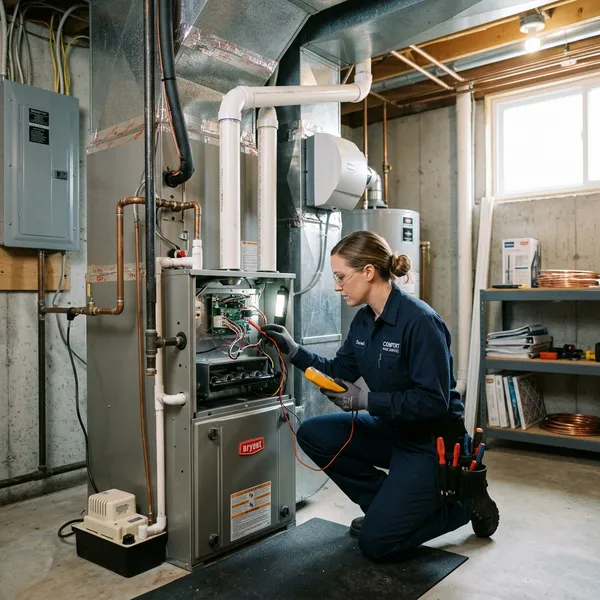
Greensburg homeowners frequently struggle with deciding whether to sink more money into repairing an aging heating unit or investing in a modern replacement. Rather than leaving this decision to guesswork, our certified technicians guide you through objective mathematical formulas and safety assessments used across the mechanical engineering industry.
Take the exact age of your existing heating system in years and multiply it by the cost of the proposed repair. If the resulting number exceeds $5,000, replacement is statistically the more financially sound decision:
Example A (Repair Makes Sense):
A 7-year-old heater needing a $350 draft inducer motor: 7 × $350 = $2,450. (Under $5,000: Proceed with repair).
Example B (Replacement Recommended):
A 15-year-old heater needing a $480 blower motor replacement: 15 × $480 = $7,200. (Over $5,000: Replace the unit).
Units over 12 to 15 years old enter a period of cascading component failures where fixing one weak part simply transfers stress to the next aging component.
If an individual mechanical repair estimate exceeds 50% of the replacement value of the heating system, spending that money on an out-of-warranty unit is an unwise financial gamble. Furthermore, specific mechanical conditions make replacement mandatory:
| Evaluation Factor | When to Repair Your System | When Replacement is Strongly Advised |
|---|---|---|
| System Age | Under 10 to 12 years old | 15 to 25+ years old (past rated design life) |
| Repair Frequency | First breakdown in multiple heating seasons | Two or more service calls in the past 24 months |
| Heat Exchanger Condition | 100% intact, zero micro-fractures or rust perforations | Hairline cracks, rust pitting, or CO leakage |
| Winter Gas Bills | Stable, consistent with local gas utility tariff rates | Climbing 15% to 30% without increases in gas usage |
| Operating Sound | Standard baseline combustion and fan noise | Loud screeching, metal grinding, or booming ignition |
| Room Comfort Balance | Even temperature distribution across the home | Severe temperature swings and ice-cold perimeter rooms |
| Warranty Status | Covered under active 10-year manufacturer warranty | Completely out of warranty; all replacement parts paid out-of-pocket |
Early Warning Indicators
Heaters rarely fail without warning. In the weeks and months leading up to a total shutdown during a sub-zero Greensburg cold snap, failing units exhibit telltale mechanical and acoustic symptoms. Recognizing these signs early allows you to plan an orderly replacement before you are left without heat.
A healthy natural gas heater produces a crisp, steady blue flame. A flickering yellow or orange flame indicates incomplete combustion, dirty or misaligned burner orifices, or a dangerous lack of oxygen. If you notice black soot accumulating around the burner sight glass or flue access panel, carbon monoxide is actively leaking.
When a heater turns on for 3 to 5 minutes, shuts off abruptly, and restarts repeatedly without satisfying the thermostat, it is short-cycling. This is frequently triggered by an overheating heat exchanger tripping high-limit safety switches, clogged internal passages, or failing flame sensor circuits that wear down control boards.
As blower motors lose torque and heat exchanger cells become obstructed by rust scale, the system cannot maintain sufficient static airflow. Homeowners in multi-level Greensburg homes notice rooms furthest from the equipment remain freezing cold while rooms near the basement overheat.
Loud popping or banging sounds upon startup indicate delayed ignition: gas builds up in the burner chamber before igniting violently, placing immense shock on the heat exchanger. Screeching or rattling noises signal failing draft inducer bearings or worn blower motor shafts.
As internal combustion efficiency drops from age and soot build-up, older heaters burn 30% to 50% more natural gas simply to produce the same volume of heat. If your gas bill is substantially higher than your neighbors in Greensburg with similar square footage, your heater has lost its thermodynamic efficiency.
Aging heating systems dry out indoor air rapidly, cracking wood flooring and aggravating respiratory passages. Corroded draft hoods and degraded duct connections draw dusty basement air directly into the supply airstream, coating furniture in fine grit despite regular filter changes.
Architectural Engineering Adaptations
Replacing a heating system in a 1910 solid-brick colonial in Academy Hill requires completely different engineering protocols than replacing a unit in a 1970s split-level in Fort Allen or a modern residence in Hempfield Township. Our installation teams have decades of localized mechanical experience across Westmoreland County.
Historic Greensburg homes typically feature stone foundation basements with low ceiling clearances, narrow staircases, and old gravity duct trunks. Many original chimney flues have deteriorating clay liners unsuitable for modern exhaust.
Our Replacement Protocol:
• Custom compact high-efficiency cabinet sizing to navigate narrow basement stairs.
• Direct-vent concentric PVC routed through rim joists, completely bypassing unlined brick chimneys.
• Aerodynamic sheet metal plenum transitions to mate modern ECM blowers with converted gravity duct systems.
Greensburg expansive suburban ranches feature extended horizontal duct runs where static pressure losses result in cold outer bedrooms. Multi-level split designs suffer from thermal layering where basement dens stay freezing while upstairs bedrooms overheat.
Our Replacement Protocol:
• Variable-speed constant-torque ECM motors configured to overcome high static resistance.
• Enclosing and expanding return air drops to eliminate static choke points.
• Two-stage burner staging that runs gently on low stage 80% of the winter to balance room temperatures.
Modern custom homes throughout suburban Hempfield Township feature tight thermal building envelopes, cathedral ceilings, and large open floor plans. While well-insulated, they require precision air turnover to prevent heat from stratifying in upper ceiling vaults.
Our Replacement Protocol:
• 97%+ AFUE fully modulating systems paired with smart communicating controls.
• Continuous low-speed fan circulation that de-stratifies air without creating noticeable drafts.
• Integration with bypass or steam whole-home humidifiers to protect hardwood flooring and woodwork.
Modern Technology Options
When replacing an aging heater, selecting the right efficiency tier determines your long-term energy savings, operating sound, and room comfort balance. Review our comprehensive technical comparison of standard, high-efficiency condensing, and premium modulating systems:
| Engineering Specification | Standard 80% AFUE | High-Efficiency 96% AFUE (Top Value) | Premium 98% Modulating AFUE |
|---|---|---|---|
| AFUE Efficiency Rating | 80.0% AFUE | 96.0% to 96.5% AFUE | 97.5% to 98.7% AFUE |
| Burner Staging Control | Single-Stage (Full power 100% On or Off) | Two-Stage (Low 65% / High 100%) | Modulating (40% to 100% in 1% steps) |
| Blower Motor Technology | Standard PSC Motor (High electrical usage) | Multi-Speed Constant Torque ECM Motor | Variable-Speed Communicating ECM Motor |
| Combustion Flue Venting | Metal B-Vent into lined chimney flue | Direct-Vent Schedule 40 PVC / Polypropylene | Direct-Vent Concentric PVC Sidewall/Roof |
| Combustion Air Source | Draws conditioned indoor basement air | 100% Sealed outdoor intake air pipe | 100% Sealed outdoor intake air pipe |
| Temperature Variance Range | ± 3.0°F to 4.5°F (Noticeable drafts) | ± 1.0°F to 1.5°F (Steady warmth) | ± 0.5°F (Pinpoint constant comfort) |
| Estimated Winter Gas Savings | Baseline (Replaces obsolete 60-70% unit) | 22% to 28% annual gas savings | 32% to 38% annual gas savings |
| Acoustic Sound Level | 68 - 72 dBA (Noticeable rush of air) | 58 - 62 dBA (Quiet conversational level) | 48 - 54 dBA (Whisper-quiet continuous air) |
| Rebates & Tax Credits | Not eligible for rebates or credits | Eligible for Peoples/Columbia Gas Rebates | Up to $600 Federal 25C Credit + Utility Rebates |
Recommendation for Greensburg: For most homes in Westmoreland County, a 96% Two-Stage Condensing unit provides the best return on investment, balancing upfront installation costs with massive fuel reductions and local utility cash rebates.
Compare Models with a SpecialistOur Installation Quality Standard
A premium replacement heating unit will fail prematurely if connected to sloppy ductwork, improper venting, or uncalibrated gas trains. At Greensburg Heating & Cooling, every replacement follows our strict 10-stage engineering checklist to ensure maximum efficiency, quiet operation, and total safety.
We lay heavy-duty neoprene drop runners along all entryways, stairs, and basement pathways. Our technicians wear protective shoe covers and stage containment drop cloths to keep your home immaculate.
We safely isolate electrical circuits, shut off gas supply valves, and disconnect the obsolete equipment. The old unit is disassembled, hauled out of your basement, and delivered to local recycling facilities for metal scrap recovery.
Modern replacement heaters differ in physical height and width from 20-year-old units. We measure, cut, and hand-brake custom galvanized sheet metal supply and return transitions with turning vanes to ensure smooth, non-turbulent airflow.
We mount the replacement heating unit on an elevated composite equipment pad or cork-and-rubber vibration isolators. This prevents basement slab moisture from corroding the bottom cabinet and isolates mechanical motor hum.
For 90%+ condensing units, we drill through rim joists to run solid-core Schedule 40 PVC or polypropylene venting. We pitch all exhaust runs at 1/4 inch per foot back toward the internal drain, safely isolating flue gases from old masonry chimneys.
We install heavy-gauge black iron gas pipe with a dedicated 1/4-turn shutoff valve, ground-joint union, and a vertical sediment drip leg trap. We perform a high-pressure manometer leak test to verify 100% gastight integrity.
High-efficiency heaters produce up to 5 gallons of acidic condensation daily (pH 3.0 to 4.0). We route clear PVC drain lines through a limestone condensate neutralizer cartridge to safeguard your home drain pipes and cast iron sewer plumbing from acid erosion.
We install a dedicated 4-inch deep pleated media filter cabinet directly between the return duct and the blower. All duct seams, canvas collars, and plenum joints are sealed air-tight with mastic foil tape to prevent basement dust infiltration.
We insert dual-port digital manometers to verify supply and return Total External Static Pressure (TESP) is below 0.50 in. w.c. Then, our digital combustion analyzer tests flue gas to confirm oxygen levels, zero draft back-pressure, and carbon monoxide under 50 ppm.
Our lead technician demonstrates how to operate your new smart thermostat, guides you through changing the 4-inch air filter, reviews safety shutoffs, and completes your 10-year manufacturer warranty registration on your behalf.
Legal Code Compliance
Residential heating replacements in Greensburg must comply with the Pennsylvania Uniform Construction Code (PA UCC), incorporating the International Residential Code (IRC) and NFPA 54 National Fuel Gas Code. Unpermitted, non-code installations create severe fire risks, carbon monoxide dangers, and can void your homeowners insurance policy.
Direct-vent PVC exhaust terminals must be installed at least 18 inches above anticipated snow accumulation levels in Westmoreland County, at least 3 feet above any forced air inlet within 10 feet, and at least 4 feet horizontally from gas meters and electrical service heads.
Every gas heating replacement requires a dedicated, full-port brass shutoff valve within 6 feet of the unit, a ground-joint union downstream, and an accessible 3-inch sediment drip leg to trap rust and scale before gas reaches the automatic modulating valve.
Central heating equipment must be served by a dedicated 15A or 20A branch circuit with an electrical service switch located within direct line-of-sight of the cabinet. We inspect wiring gauges and verify proper grounding to prevent electrical surges.
Upgrading your heating system in Greensburg unlocks substantial financial incentives through the Federal Inflation Reduction Act (IRA) Section 25C and local Pennsylvania natural gas utilities. Our office team handles all AHRI certification paperwork to ensure you receive every dollar you qualify for.
Direct dollar-for-dollar tax credit on qualifying 97%+ AFUE natural gas heating systems installed in your primary residence.
Direct cash-back equipment rebates from Westmoreland County natural gas distribution companies for high-efficiency replacements.
Electric utility credits when pairing your replacement system with an ENERGY STAR approved smart communicating thermostat.
Based on 123+ local reviews
"Caleb performed a thorough check of my furnaces in Greensburg. I always trust the work this team and their technicians do. Arrived right on time and explained everything clearly."
"I was very satisfied and pleased with all the work done by Caleb and Brett. I needed a large variety of heating jobs done and each one was completed cleanly without any mess."
"They were able to get us in fast even though it was really hot outside and they were extremely busy. Great job! I would definitely use them again for our residential cooling needs."
Clear, upfront answers to common questions about residential HVAC service, pricing, and emergency response in Greensburg, PA.
Our local technicians are based directly in Greensburg, PA, allowing us to arrive at your doorstep swiftly for scheduled maintenance and 24/7 heating or cooling emergencies.
Greensburg
PA 15601
South Greensburg
PA 15601
Southwest Greensburg
PA 15601
Jeannette
PA 15644
Irwin
PA 15642
North Huntingdon
PA 15642
Murrysville
PA 15668
Delmont
PA 15626
Penn Township
PA 15644
Latrobe
PA 15650
Hempfield Township
PA 15601
Youngwood
PA 15697
Call our Greensburg dispatch office to verify immediate technician availability in your neighborhood.
Do not wait for a complete heating breakdown in the dead of winter. Contact Greensburg Heating & Cooling today for an honest, scientific evaluation of your home heating system. We provide accurate ACCA Manual J load calculations, clear repair vs. replace comparisons, and guaranteed flat-rate quotes.
Have questions about heat pumps, AFUE ratings, or financing? Speak directly with our replacement specialists.
📞 Call (724) 482-3710Complete the brief form below and our heating replacement specialist will confirm your assessment appointment.
Centrally located on S Pennsylvania Ave, our mobile service trucks are dispatched directly across Greensburg, Hempfield Township, South Greensburg, and throughout Westmoreland County.
140 S Pennsylvania Ave, Greensburg, PA 15601, USA
Call: (724) 482-3710
24/7/365 Emergency Dispatch Ready
Our certified HVAC specialists are on standby 24 hours a day to restore comfort to your home. Fast diagnostics, upfront quotes, and zero hassle.